
HOME > BRIDGE LESSONS > DECLARER CARD PLAY LESSONS
Ducking
When you know you have to lose at least one trick in a suit that includes the ace and king, you need to lose that trick early by playing low cards from both your hand and the dummy. This is called ducking a trick.
When should I not play my honor cards?
Definition
In contract bridge, to duck means to deliberately play low to a trick which you have led and intentionally losing in order to set up a suit or to preserve controls or entries. When applied to a suit you have led it is referred to as a duck but it is called a hold-up when you purposely play a low card in a suit played by the opponents when you could win the trick.
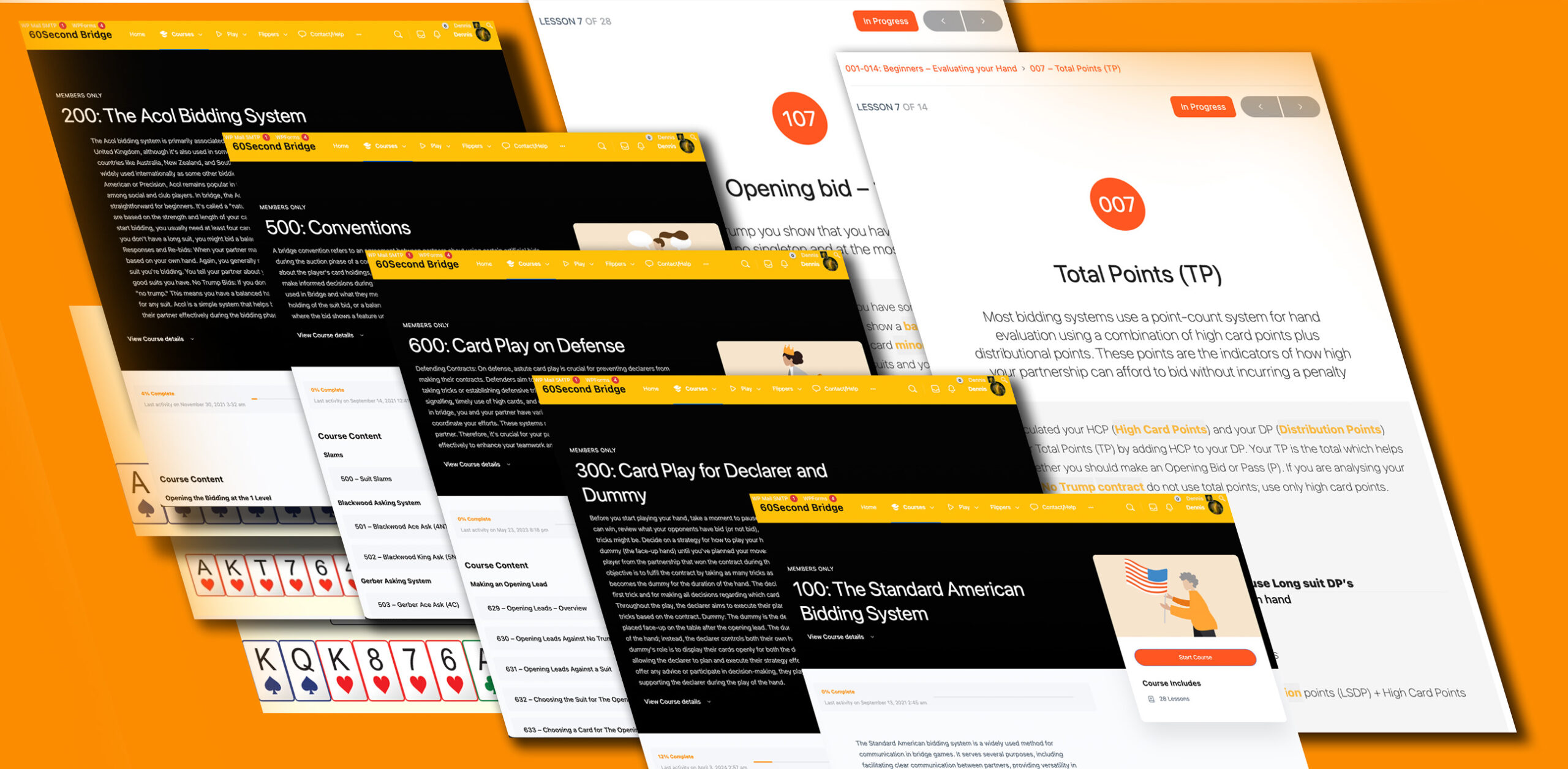
This page is a ‘lite’ version of the interactive Bridge
lessons available in our Premium Members area.
Subscribe to our ‘Hand of the Week’ newsletter and get instant access to 31 interactive Bridge lessons and 32 guided Bridge games in our Premium Members area.
Our Premium Member area also includes
hundreds of interactive Bridge lessons covering:
Standard American Bidding, Acol Bidding, Conventions, Defensive Bidding, Defensive Card play, Decrlarer Play lessons plus – daily Bridge competitions, daily guided Bridge hands, ‘extra for experts’ Bridge games, inline Bridge glossary, instant-answer quizzes and much more.
Try it Free Today.
The Problem
If the dummy has a five-card suit headed by the ace and the king facing three small cards, you want to create two extra tricks using a ducking play.
The opponents have five spades between the two hands, including the spade queen and Jack. You must sooner or later lose a spade trick no matter what, so try lose it as soon as you can while you still have control of the suit
North
North (Dummy)
♠ 6 5 3
West
West
♠ Q 10 9
East
East
♠ J 8
South
South (Declarer)
♠ A K 7 4 2


